



Which Electric Suspension Shocks can Bear Your Ass?
2025-10-10
If you’ve ever been annoyed by a bumpy ride, you know how much your car’s suspension matters.
Think about it: that jarring "thud-thud" when crossing speed bumps, the scary body roll during high-speed turns that nearly spills your passenger’s coffee, or rear seat family members complaining about motion sickness forcing you to drive extra cautiously - these all come down to your suspension shocks.
Today, traditional spring shocks are no longer the only option, with the rise of new vehicle technologies, electronic shock absorber technologies like FSD, CDC, and MRC are gradually moving from advanced models to family cars.
Think about it: that jarring "thud-thud" when crossing speed bumps, the scary body roll during high-speed turns that nearly spills your passenger’s coffee, or rear seat family members complaining about motion sickness forcing you to drive extra cautiously - these all come down to your suspension shocks.
Today, traditional spring shocks are no longer the only option, with the rise of new vehicle technologies, electronic shock absorber technologies like FSD, CDC, and MRC are gradually moving from advanced models to family cars.
What exactly are these letter combinations, and how do they turn rough rides into smooth ones? Let’s break it down now.
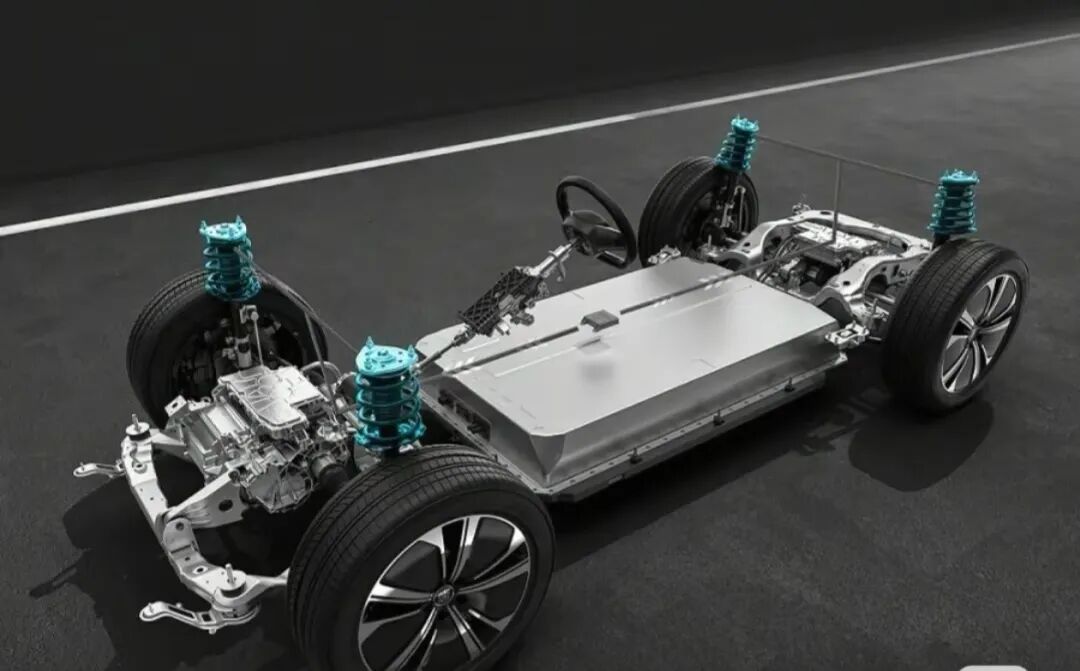
Car Suspension "Black Technology": FSD, CDC, MRC – Which Electric Shock Absorber Truly Understands Your ASS?
Have You Had These Driving Experiences?
- That "thud-thud" when going over speed bumps, so jarring that it makes you question if your car’s suspension is even working.
- Body roll during high speed turns, almost spilling your passenger’s coffee?
- Rear seat family members complaining about motion sickness, making you drive extra carefully?
Your car’s suspension system quietly determines the comfort and stability of every trip.
Today, traditional spring shock absorbers are no longer the sole choice, with the popularity of new vehicle technologies, electronic shock absorber technologies are gradually moving from luxury cars to ordinary family cars.
Today, traditional spring shock absorbers are no longer the sole choice, with the popularity of new vehicle technologies, electronic shock absorber technologies are gradually moving from luxury cars to ordinary family cars.
So, what exactly are FSD, CDC, and MRC? And how do they turn bumpy rides into smooth, comfortable ones?
FSD Shocks: The "Adaptive Valve" Genius
FSD stands for Frequency Selective Damping, literally "frequency-selective shock absorption." It’s like a "passive" smart component in your car’s suspension.
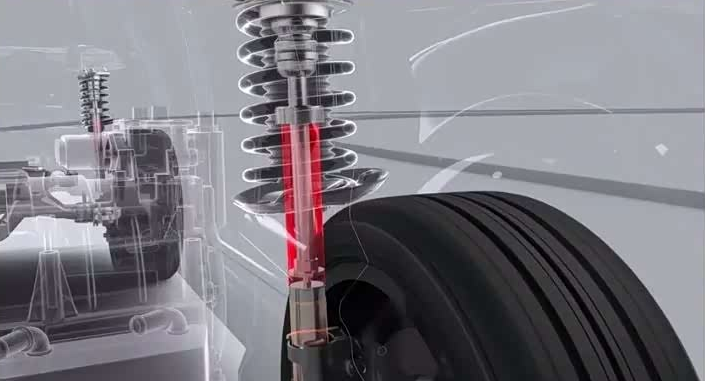
Core Principle
Imagine a clever valve inside the shock absorber, equipped with a set of special small holes and channels.
- When the wheels hit small, frequent bumps (high-frequency vibrations), the valve restricts the flow speed of the shock oil, making the shock absorber "stiffer" and reducing body sway.
- When the wheels hit large potholes or the car is cornering (low-frequency, large-magnitude movements), the valve opens wider, allowing the oil to flow more freely. This makes the shock absorber "softer" and absorbs impacts more thoroughly.
Features
- Relatively simple and reliable structure, usually the lowest cost among the 3 technologies.
- No additional sensors or electronic control units are needed; it responds to road conditions purely through its mechanical structure.
- Improves ride comfort while maintaining a certain level of support, making it ideal for upgrading family cars.
CDC Shocks: The Sharp "Electronic Brain"
CDC stands for Continuous Damping Control, or "continuous damping control." It has entered the realm of "active" adjustability.
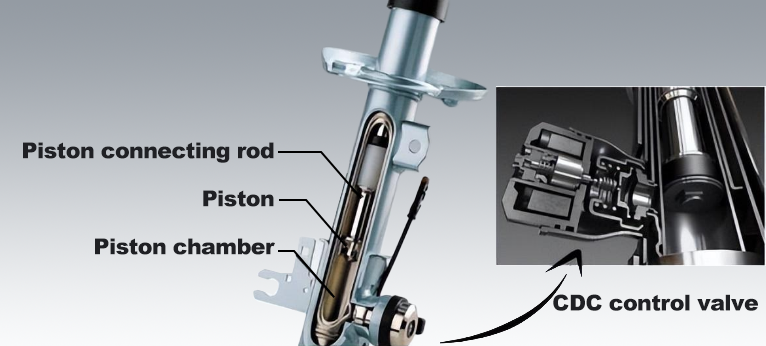
Core Principle
Inside the CDC shock absorber, a solenoid valve controls the valve opening.
The car is equipped with sensors (such as acceleration sensors and height sensors) that constantly monitor road conditions and vehicle dynamics.
The on board computer acts like a "brain": it analyzes data in an instant and adjusts the solenoid valve opening within milliseconds, changing the resistance of oil flow to infinitely adjust the stiffness of the shock absorber.
The car is equipped with sensors (such as acceleration sensors and height sensors) that constantly monitor road conditions and vehicle dynamics.
The on board computer acts like a "brain": it analyzes data in an instant and adjusts the solenoid valve opening within milliseconds, changing the resistance of oil flow to infinitely adjust the stiffness of the shock absorber.
Features
- Truly active real time adjustment with fast response (millisecond-level).
- Can be optimized for comfort (filtering out bumps) or handling (suppressing body roll/nose dive) based on needs.
- More complex system with higher costs, relying heavily on software algorithms for precise control.
MRC Shocks: The Lightning Fast "Magnetic Flow Magic"
MRC stands for Magnetic Ride Control, or "magnetorheological shock control." It’s the "black technology" flagship of General Motors (GM), pushing response speed to the limit.
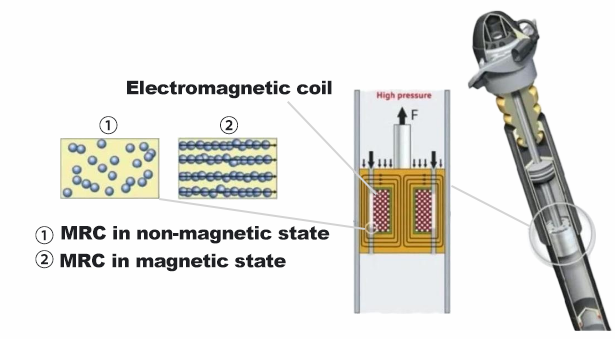
Core Principle
The MRC shock absorber is filled with a special magnetorheological fluid (containing tiny magnetic particles).
Instead of a traditional valve, it uses electromagnetic coils.
When electricity is applied, the magnetic field instantly changes the arrangement of particles in the fluid, making its viscosity increase sharply (to nearly a solid state) and thus changing the damping force.
When the power is cut off, the fluid returns to a liquid state, and the damping force decreases accordingly.
Instead of a traditional valve, it uses electromagnetic coils.
When electricity is applied, the magnetic field instantly changes the arrangement of particles in the fluid, making its viscosity increase sharply (to nearly a solid state) and thus changing the damping force.
When the power is cut off, the fluid returns to a liquid state, and the damping force decreases accordingly.
Features
- Unmatched response speed up to milliseconds or even microsecond level, enabling more precise and delicate adjustments.
- No traditional valve structure, theoretically more durable and reliable.
- Complex technology with high costs; it was exclusive to high-end models for years.
Key Differences: FSD vs. CDC vs. MRC
| Feature | FSD (Frequency Selective Damping) | CDC (Continuous Damping Control) | MRC (Magnetic Ride Control) |
|---|---|---|---|
| Adjustment Method | Passive Adaptive | Active Electronic Adjustment | Active Electronic Adjustment |
| Core Components | Special Mechanical Valve Structure | Solenoid Valve | Magnetorheological Fluid + Electromagnetic Coil |
| Response Speed | Relatively Slow | Fast (Millisecond-Level) | Extremely Fast (Microsecond-Millisecond Level) |
| Requires Power/Sensors | No | Yes | Yes |
| Tech Complexity/Cost | Low | Medium-High | Highest |
| Main Advantages | Low cost, high reliability, significant comfort improvement | Real-time active adjustment balances comfort and handling | Lightning-fast response, top-tier performance, smooth ride |
| Typical Applications | Upgrade for main family cars | Mid-to-high-end luxury/performance cars | Top-tier performance cars/luxury cars |
Is It Worth Paying Extra for These Technologies When Buying a Car?
- For budget-conscious family car upgrades: FSD is a practical choice. It delivers noticeable comfort improvements at a relatively low cost.
- For those seeking a balanced, all-around experience: CDC technology is becoming increasingly popular. It optimizes both comfort and handling, making it ideal for mid-to-high-end car owners who value quality.
- For extreme performance and response: If you have a generous budget and love driving, models equipped with MRC can provide the stability and road feel of "ground-hugging driving" (a smooth, stable ride that feels like gliding close to the road).
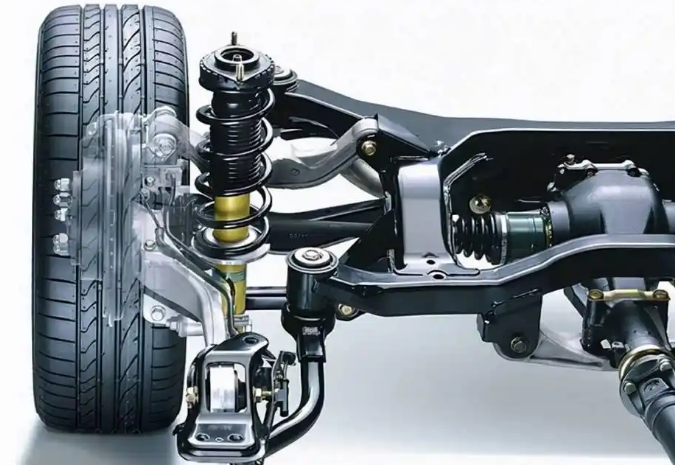
Next time you drive a car, don’t just focus on the infotainment screen or leather seats. Drive over a speed bump and take a sharp turn, feeling the subtle differences from the chassis.
A set of smart electromagnetic shock absorbers might be the "invisible technology" that blocks noise and bumps. Your driving experience deserves this level of smooth, intelligent comfort.
Please contact us if you want to inquire about the price of shock absorbers or struts.
A set of smart electromagnetic shock absorbers might be the "invisible technology" that blocks noise and bumps. Your driving experience deserves this level of smooth, intelligent comfort.
Please contact us if you want to inquire about the price of shock absorbers or struts.