



P0011 Code Cadillac Camshaft Position Timing over Advanced
2025-12-02
In this blog, I’ll share a tricky P0011 Cadillac repair case that had me stuck initially, until I switched up my diagnostic approach. For those dealing with p0011 (also known as po011, which stands for camshaft position timing over Advanced Bank 1), this case will shed light on how mechanical timing checks can be misleading, and how using an oscilloscope can save time and avoid unnecessary disassembly.
Whether you’re facing p0011 Cadillac Escalade or another Cadillac model, the diagnostic logic here applies. I’ll walk through the fault verification, code analysis, the dilemma I faced, and the final solution that resolved the issue completely.
Whether you’re facing p0011 Cadillac Escalade or another Cadillac model, the diagnostic logic here applies. I’ll walk through the fault verification, code analysis, the dilemma I faced, and the final solution that resolved the issue completely.
Step 1: Fault Verification and Initial Code Reading
My first step was always to verify the fault Phenomenon (symptoms) through a test drive. When I started the engine, the check engine light came on immediately, and there was obvious rough idling. Interestingly, when I pressed the accelerator pedal, the engine accelerated without any obvious abnormalities, this contrast gave me the first clue that the issue was likely related to idle or timing rather than general engine power.
Next, I used a General Diagnostic System (GDS) to scan the Engine Control Module (ECM). The results showed three current fault codes: P0011 (Intake Camshaft Position System Performance), P0016 (Crankshaft Position Intake Camshaft Position Correlation), and P05CC (Cold Start Intake Camshaft Position System Performance, Bank 1). For context, P0011 Cadillac translates to camshaft position timing over Advanced Bank 1 (po011 for short), a common code that points to variable valve timing (VVT) adjustment errors during engine operation.
The setting condition for P0011 and P05CC is similar: a large deviation between the expected and actual intake camshaft positions, more than 3° crank angle when cold and over 6° when warm. P0016, however, is more critical: it indicates a basic engine timing error, triggered when the ECM compares the crankshaft position sensor and intake camshaft position sensor signals and detects a deviation greater than -8° crank angle in one direction or 9° in the other.
The setting condition for P0011 and P05CC is similar: a large deviation between the expected and actual intake camshaft positions, more than 3° crank angle when cold and over 6° when warm. P0016, however, is more critical: it indicates a basic engine timing error, triggered when the ECM compares the crankshaft position sensor and intake camshaft position sensor signals and detects a deviation greater than -8° crank angle in one direction or 9° in the other.
Step 2: Initial Suspicions – Engine Timing Error
I recorded all the fault codes and cleared them before test-driving again. As soon as I started the engine, the P0016 code reappeared immediately. This reinforced my initial suspicion: there was an issue with the engine’s basic timing. For any Cadillac owner, especially those with a P0011 Cadillac Escalade, a recurring timing related code like P0016 would typically lead to checking the timing chain installation first, and that’s exactly what I did next.
Step 3: Timing Calibration – No Mechanical Issues Found
Following the service manual guidelines, I set out to verify the engine timing. I removed the camshaft positioning hole plugs and the starter motor, then slowly turned the flywheel until the locking tool fit perfectly into the flywheel. I then used a camshaft locking tool to secure both the intake and exhaust camshafts. To my surprise, everything checked out, the timing chain was installed correctly, and the mechanical timing between the camshaft and crankshaft was accurate. This was a problem: my initial diagnosis hit a wall.
If I followed the service manual further, I’d have to perform extensive disassembly, including removing the front cover to check the timing chain slack and tensioner condition, inspecting the installation of the camshaft and crankshaft position sensors, removing the transmission to check if the relucter ring was aligned with the crankshaft, and disassembling the VVT solenoid to check for jamming. The workload would be enormous, so I decided to pivot and use an oscilloscope to diagnose the timing fault without major disassembly, hoping to develop a more efficient diagnostic process.
If I followed the service manual further, I’d have to perform extensive disassembly, including removing the front cover to check the timing chain slack and tensioner condition, inspecting the installation of the camshaft and crankshaft position sensors, removing the transmission to check if the relucter ring was aligned with the crankshaft, and disassembling the VVT solenoid to check for jamming. The workload would be enormous, so I decided to pivot and use an oscilloscope to diagnose the timing fault without major disassembly, hoping to develop a more efficient diagnostic process.
Step 4: Breakthrough with Oscilloscope Testing
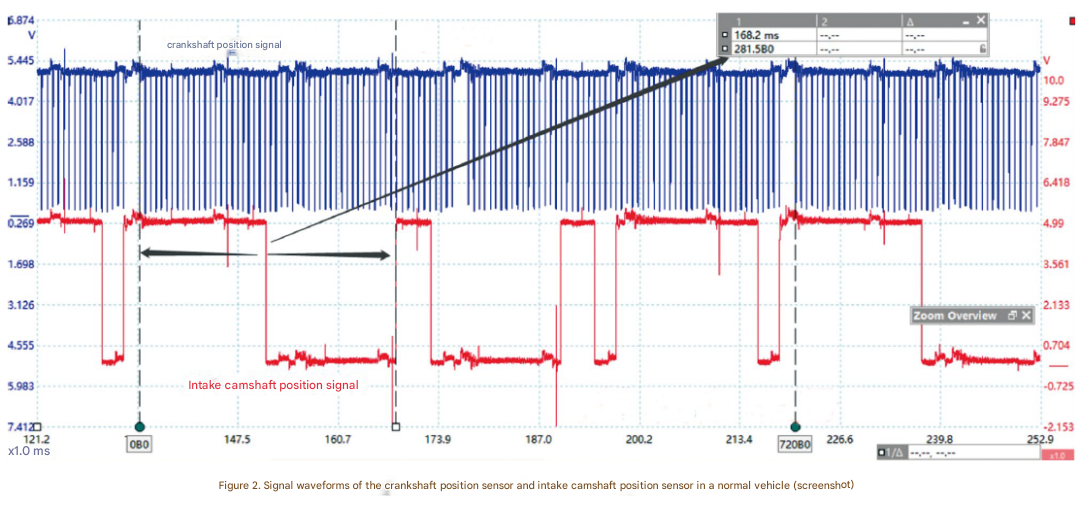
I used the oscilloscope to measure the signal waveforms of the crankshaft position sensor and the intake camshaft position sensor, then compared them with the waveforms of a normal Cadillac. The difference was clear: the intake camshaft angle of the faulty vehicle was advanced by approximately 60° crank angle. This was confusing because the front timing chain had been calibrated correctly with the locking tool, but the ECM was detecting an incorrect relative position between the rear signal tooth of the intake camshaft and the crankshaft via the intake camshaft position sensor. My new suspicion was that the intake camshaft signal tooth had shifted position relative to the intake camshaft.
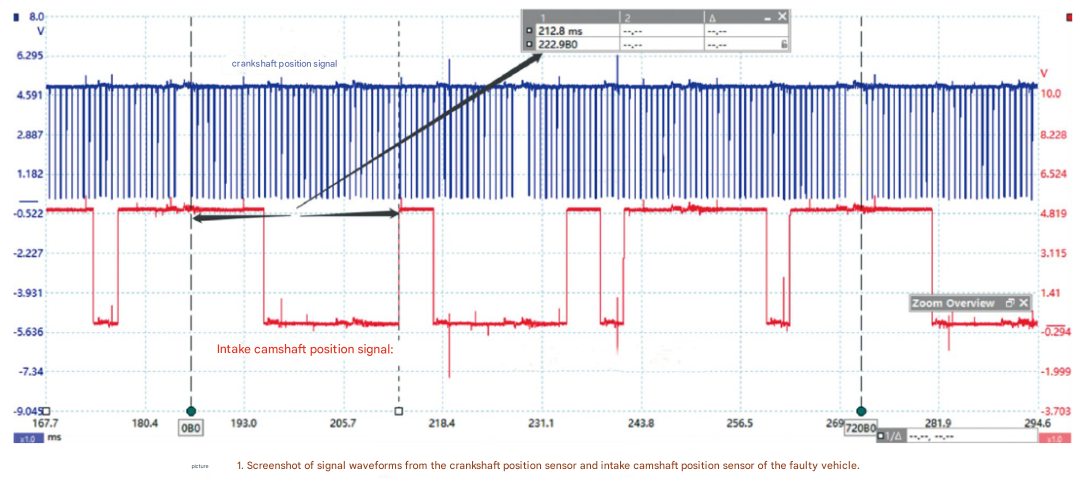
To verify this, I used the camshaft locking tool to secure the intake camshaft, then observed the position of the signal tooth through the intake camshaft position sensor installation hole. It matched the position of a normal vehicle almost exactly, so I ruled out the possibility of the intake camshaft signal tooth being misaligned. I had to rethink my approach.
Step 5: Narrowing Down to VVT Solenoid Fault
I rearranged my repair thinking and deduced two possible remaining fault causes: either the intake camshaft VVT control solenoid was stuck in the normally open position, or the intake camshaft VVT control sprocket was intermittently stuck in the maximum advance position. Given that disassembling the solenoid was less invasive than checking the sprocket, I decided to inspect the intake camshaft VVT control solenoid first. When I removed and disassembled it, I found the valve core was indeed stuck in the fully open position, this was the root cause!
Step 6: Fault Resolution – Replacing the VVT Solenoid
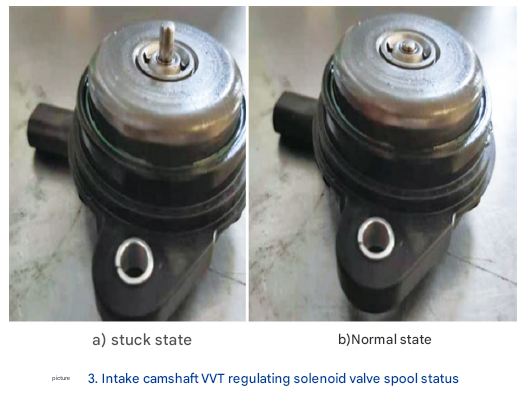
I replaced the faulty intake camshaft VVT control solenoid with a new OEM part, then test drove the vehicle repeatedly. The check engine light didn’t come back on, the rough idling disappeared, and none of the fault codes (including P0011, P0016, and P05CC) reappeared. The fault was completely resolved. For anyone dealing with p0011 (camshaft position timing over Advanced Bank 1) in their Cadillac, this shows how a seemingly complex timing issue can sometimes be traced to a single faulty component like the VVT solenoid.
Fault Summary: Understanding the Root Cause
Let me break down why this happened: the intake camshaft VVT control solenoid was stuck in the normally open position. As soon as the engine started, oil pressure pushed the intake camshaft into the maximum advance position, causing the timing deviation detected by the ECM and triggering the fault codes.
However, when the engine was turned off and the crankshaft was rotated to the timing locked position, the intake camshaft reset to its normal position, this is why the mechanical timing check showed no issues when the engine was off, but the fault reappeared as soon as the engine started. This tricky interaction is what made the initial diagnosis challenging, but using the oscilloscope helped me bypass unnecessary disassembly and get straight to the root cause.
However, when the engine was turned off and the crankshaft was rotated to the timing locked position, the intake camshaft reset to its normal position, this is why the mechanical timing check showed no issues when the engine was off, but the fault reappeared as soon as the engine started. This tricky interaction is what made the initial diagnosis challenging, but using the oscilloscope helped me bypass unnecessary disassembly and get straight to the root cause.
Key Takeaways for P0011 Cadillac Owners
If you’re facing P0011 Cadillac (or po011, camshaft position timing over Advanced Bank 1), whether it’s a P0011 Cadillac Escalade or another model, don’t jump straight to extensive timing chain disassembly.
Sometimes, the issue is with the VVT solenoid rather than the mechanical timing itself. Using diagnostic tools like an oscilloscope can save time and money by pinpointing the exact fault without tearing down half the engine. Always verify your initial assumptions and be willing to pivot your diagnostic approach if things don’t add up, this is what ultimately led me to solve this case efficiently.
Sometimes, the issue is with the VVT solenoid rather than the mechanical timing itself. Using diagnostic tools like an oscilloscope can save time and money by pinpointing the exact fault without tearing down half the engine. Always verify your initial assumptions and be willing to pivot your diagnostic approach if things don’t add up, this is what ultimately led me to solve this case efficiently.