



P0300 Buick po300 Code Random Multiple Cylinder Misfire
2025-11-24
What is P0300 Buick (po300 Random Multiple Cylinder Misfire)?
First, let’s break down the basics: p0300 buick means your engine is experiencing “random multiple cylinder misfire”, in other words, one or more cylinders aren’t burning fuel properly, and the misfire isn’t limited to a single cylinder (that would be a P0301-P0308 code).
When a cylinder misfires, it leads to three big problems: higher fuel consumption, emissions, and noticeable loss of power.
From my experience with Buick Enclave P0300 and P0300 Buick Lesabre models, misfires can be categorized in two ways:
From my experience with Buick Enclave P0300 and P0300 Buick Lesabre models, misfires can be categorized in two ways:
- By combustion severity: Partial misfire (fuel burns incompletely, so pressure is lower than normal) or complete misfire (fuel barely burns or doesn’t burn at all, resulting in pressure ≤ 0).
- By frequency: Continuous misfire (the cylinder fails repeatedly) or single misfire (the cylinder works sometimes, misfires others).
To measure how bad partial or single misfires are, we use “misfire rate”, the percentage of pressure loss from partial misfires, or the share of misfiring cycles in single misfires.
This rate is crucial because it tells your Buick’s computer when to trigger the check engine light.
This rate is crucial because it tells your Buick’s computer when to trigger the check engine light.
How Does a Buick Detect Misfires?
Buicks (like most modern cars) rely on the crankshaft position sensor to spot misfires, and the technology has come a long way.
Unlike older models where the sensor was inside the distributor, today’s Buicks mount it at the front, middle, or rear of the crankshaft, paired with a 58X tooth wheel (this is standard for 4 cylinder Buick engines, which is why they run smoother than 3 cylinders!).
Unlike older models where the sensor was inside the distributor, today’s Buicks mount it at the front, middle, or rear of the crankshaft, paired with a 58X tooth wheel (this is standard for 4 cylinder Buick engines, which is why they run smoother than 3 cylinders!).
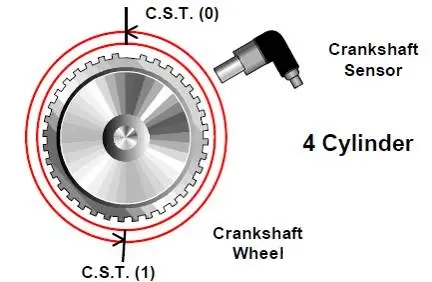
Here’s how it works, from what I’ve observed in diagnosing p0300 Buick:
- When a cylinder misfires, its combustion force is weaker than the engine computer’s baseline. This reduces pressure on the piston, slowing the crankshaft down.
- The crankshaft position sensor tracks these speed fluctuations. Paired with data from the camshaft position sensor, it identifies which cylinder is misfiring.
- The computer calculates the total misfire rate and individual cylinder rates, then compares them to a pre-set threshold. If the rate is too high, the check engine light comes on.
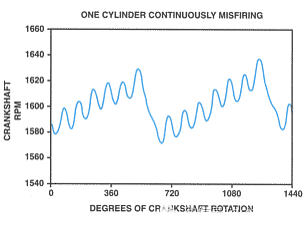
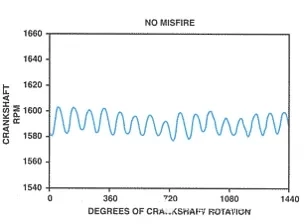
Analyzing Crankshaft Position Sensor Waveforms
I always use waveform analysis to confirm misfires, here’s what I look for:
- Normal operation (no misfires): The waveform is smooth, with small speed fluctuations (1580–1600 RPM). Why fluctuations? Engines have four strokes (intake, compression, power, exhaust) over 720° of crankshaft rotation. Only the power stroke generates acceleration; the other three consume power. A smooth waveform means consistent power delivery, key for a Buick’s performance.
- Single misfire: The waveform drops sharply between 360°–720° of rotation (still 1580–1600 RPM). This is a severe misfire, almost like a “dead cylinder.”
- Multiple misfires: The waveform jumps more dramatically (1580–1620 RPM) because the engine tries to compensate with load adjustments. Even with compensation, the waveform dips twice in a row, proof the misfire is persistent.
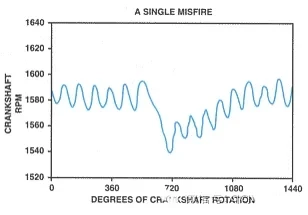
From working on Buick Enclave P0300 models, I’ve noticed that multiple misfires often show bigger RPM swings than single misfires, something to watch for during diagnosis.
When Does a Buick Run a Misfire Diagnosis?
Misfire monitoring is all about reducing emissions, so your Buick only runs the diagnosis under specific conditions (I’ve learned these from troubleshooting p0300 Buick Lesabre and other models):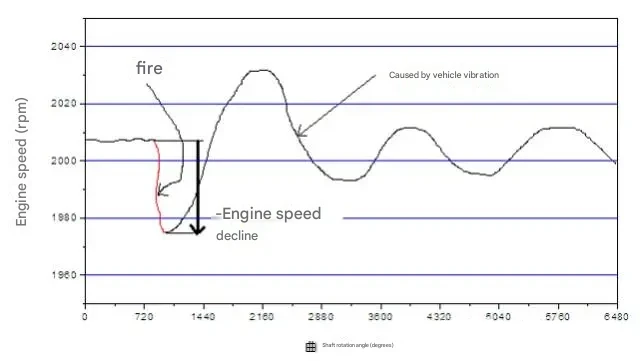
- Diagnosis starts only when engine speed and load are stable.
- No diagnosis if speed/load changes too quickly (e.g., hard acceleration).
- No diagnosis if load disturbances cause RPM fluctuations.
- No diagnosis during fuel cut-off (e.g., decelerating).
- No diagnosis if the vehicle is vibrating heavily (e.g., rough roads).
These rules prevent false P0300 codes, something that’s saved me from chasing ghost issues in Buick Enclave P0300 repairs!
How to Fix P0300 Buick: My Step-by-Step Process
The key to fixing p0300 Buick is systematic troubleshooting, not parts-swapping. Here’s my go-to method, which works for Buick Enclave p0300, Buick Lesabre p0300, and all Buick models:
1. Confirm the Code and Freeze Frame
First, use a diagnostic scanner to verify the p0300 Buick code (and rule out typos like PO300). Then pull the freeze frame data, it tells you the exact conditions (speed, load, temperature) when the misfire happened. This is critical: if the misfire occurred at 60 mph with a light load, test the car under those same conditions later.
2. Rule Out False Misfires
Clear the code, then drive the car under the freeze frame conditions. If the code doesn’t return, it might have been a one-time false trigger (e.g., bad fuel). If it comes back, you’re dealing with a real misfire.
3. Inspect the Ignition System First
Misfires almost always trace back to ignition issues. For p0300 Buick Lesabre and older Buicks, check spark plugs (worn or fouled), ignition coils (failed or weak), and spark plug wires (cracked or corroded). Newer models like the Buick Enclave might have coil-on-plug systems; test each coil with a multimeter.
4. Check Fuel Mixture Control
If the ignition system is good, the problem might be a lean or rich fuel mixture. Use your scanner to look at long-term and short-term fuel trims.
For Buick Enclave p0300, a lean mixture (high positive fuel trims) could mean a vacuum leak or clogged fuel injectors; a rich mixture (high negative trims) might point to a faulty fuel pressure regulator.
For Buick Enclave p0300, a lean mixture (high positive fuel trims) could mean a vacuum leak or clogged fuel injectors; a rich mixture (high negative trims) might point to a faulty fuel pressure regulator.
5. Verify Wiring Connections
Loose or damaged wiring to the crankshaft/camshaft sensors, MAF sensor, or oxygen sensors can cause false misfire readings.
Inspect harnesses for fraying, and make sure connectors are tight. This is a common fix for intermittent p0300 Buick issues.
Inspect harnesses for fraying, and make sure connectors are tight. This is a common fix for intermittent p0300 Buick issues.
6. Dig Deeper: Fuel Injectors, Timing, and Mechanical Issues
If the above steps don’t work, check:
- Fuel injectors (clogged or leaking, use a fuel injector cleaner or test with a flow meter).
- Ignition timing (off due to a worn timing chain/belt).
- Mechanical issues (low compression from worn piston rings or valve problems). Perform a compression test.
Wrapping Up: Beat P0300 Buick for Good
P0300 Buick (random multiple cylinder misfire) doesn’t have to be a nightmare.
By understanding how misfires work, how your Buick detects them, and following a systematic troubleshooting process, you can avoid costly overhauls.
Whether you’re fixing a Buick Enclave p0300, a p0300 Buick Lesabre, or any other Buick, remember: patience beats parts-swapping every time.
By understanding how misfires work, how your Buick detects them, and following a systematic troubleshooting process, you can avoid costly overhauls.
Whether you’re fixing a Buick Enclave p0300, a p0300 Buick Lesabre, or any other Buick, remember: patience beats parts-swapping every time.
If you’re stuck, don’t hesitate to use waveform analysis or fuel trim data; they’re your best tools for pinpointing the issue.
Happy wrenching, and here’s to getting your Buick running smooth again!
Happy wrenching, and here’s to getting your Buick running smooth again!